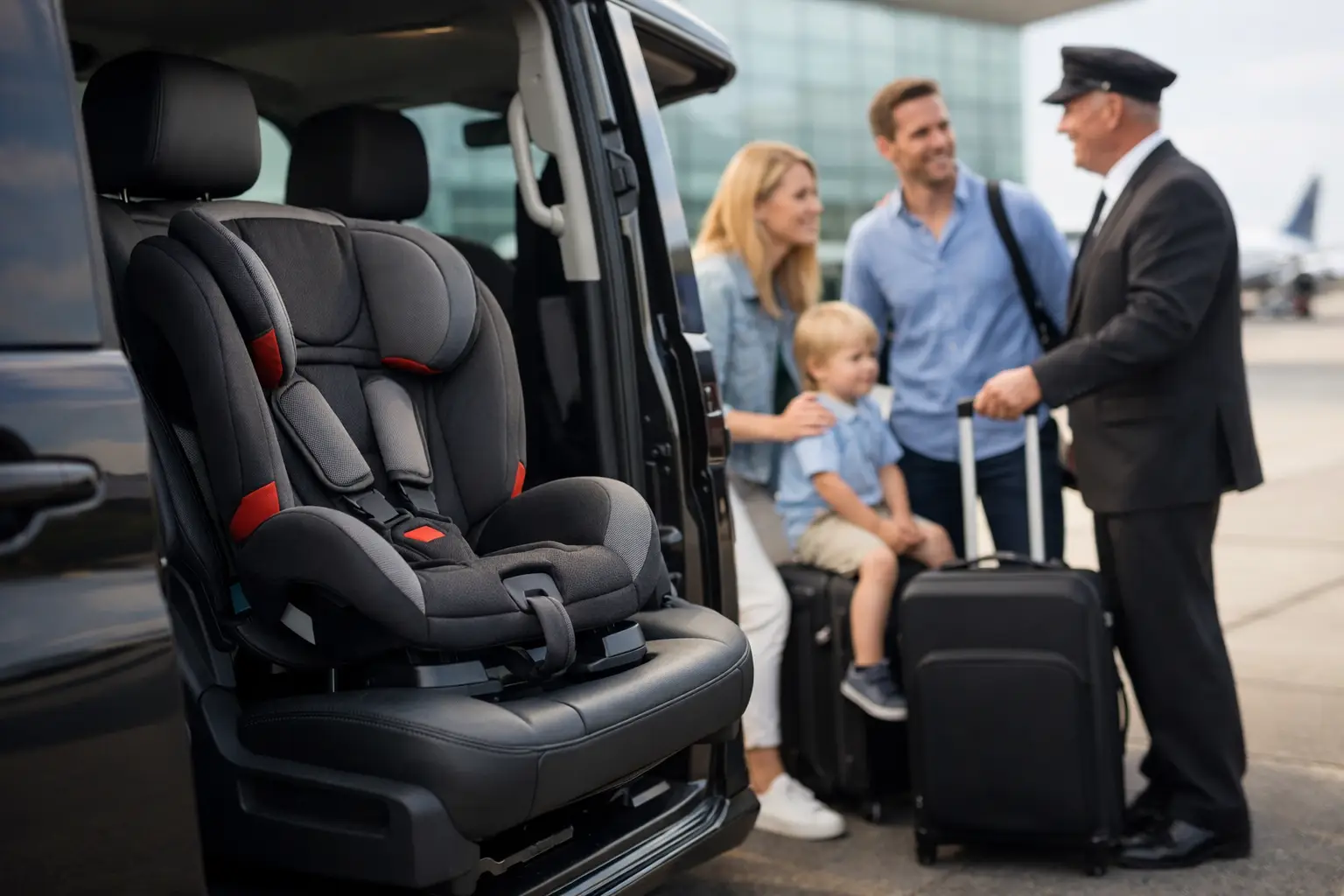
Landing with a tired toddler, a pushchair, hand luggage and a late check-in ahead is when the details start to matter. An airport transfer with child seats is not just a convenience for families. It is often the difference between a calm arrival and a stressful first hour in an unfamiliar place.
Parents usually know this already. The problem is that not every transfer service handles child seating in the same way. Some can provide the right seat if requested in advance. Others treat it as an afterthought. If you are arranging onward travel from the airport, especially after a flight into a busy holiday region, it helps to know what to check before you book.
Why an airport transfer with child seats matters
After a flight, most families want one thing: to get moving without delays. Public transport can be awkward with children, luggage and prams. Standard taxis may be available, but availability of suitable child seats is often uncertain. Even when a seat is offered, there can be questions about size, fit or whether it matches your child’s age and weight.
A pre-booked private transfer removes much of that uncertainty. The driver knows your arrival time, the route is planned, and the vehicle is prepared before you land. When child seats are included in that planning, the journey becomes simpler from the first minute outside the terminal.
That matters even more on longer journeys. A short ride into a nearby town is one thing. A transfer from the airport to a resort, villa or city further away is different. Children are more likely to fall asleep, become unsettled or need extra space. A proper seat, fitted in advance, makes the trip safer and more manageable.
What to check before booking
Not all family bookings need the same setup. The phrase airport transfer with child seats sounds straightforward, but in practice there are a few details worth confirming.
The child’s age, weight and height
This is the first point, and it should be handled clearly. Infant seats, rear-facing seats, forward-facing child seats and booster seats are not interchangeable. A provider should ask for the right information before confirming the booking, not leave it vague.
If a company only asks for the number of children, that is not always enough. Parents should expect a more precise question about ages or sizing so the correct equipment can be prepared.
Whether the seat is guaranteed in advance
There is a difference between a company that can usually provide a seat and one that confirms it as part of the booking. Families need certainty. If the seat is essential, and for most parents it is, the booking process should reflect that.
This is where private transfer services tend to be stronger than on-demand options. A pre-arranged journey allows the operator to allocate the right vehicle and seating before pickup, rather than relying on what happens to be available at the rank.
Vehicle size and luggage space
Child seats take room. So do folded buggies, travel cots and family suitcases. A vehicle that looks fine for two adults and two cases may feel tight once a child seat is fitted properly.
For that reason, it is sensible to book based on the full travel setup, not just passenger numbers. Families heading from Faro Airport to the Algarve, for example, often travel with more luggage than a standard airport run. A professional transfer company should factor this in early rather than trying to make it work on the day.
Child seats and local travel rules
Parents often ask whether child seats are legally required in every transfer vehicle. Rules can vary depending on the country, vehicle class and specific journey type. That is exactly why it is better not to rely on assumptions.
From a practical point of view, most families are not trying to interpret transport regulations in the arrivals hall. They want a safe, suitable setup ready when they walk out. Choosing a service that treats child seating as part of proper journey planning is usually the better decision than relying on minimum legal exceptions.
Safety and convenience often overlap here. Even when a short transfer might technically be possible without the ideal arrangement, most parents would prefer the correct seat fitted and waiting. That is the standard a good private transfer should aim for.
When bringing your own seat makes sense
There are situations where travelling with your own child seat is still the best option. This is more common if you are planning to hire a car later, staying for an extended period, or your child uses a very specific model that you know well.
That said, carrying your own seat through an airport has obvious downsides. It adds bulk, complicates baggage handling and creates one more thing to manage after landing. For families travelling light, a transfer service that can provide the right seat in advance is usually the easier choice.
It depends on the trip. If your airport transfer is the only road journey you need on arrival, pre-arranged seating is often more practical than bringing extra equipment from home. If you will be moving around frequently during the stay, your own seat may still be worth the effort.
What a good family transfer service should look like
A dependable family transfer is usually defined by process, not promises. It should be easy to understand what is included, when the driver will meet you, what type of vehicle is assigned and how child seating is handled.
Professional drivers matter as well. Families arriving after a delayed or early flight do not need improvisation. They need a driver who monitors the booking, meets them clearly, helps with luggage and gets the journey underway without confusion.
That is especially relevant for travellers arriving in a new country, late in the evening, or continuing on a longer route. If you are heading beyond the airport area to a resort, private accommodation or another city, a structured service becomes more valuable. Lisbon Seville Faro Riders operates in exactly that space, where planning and route experience make a noticeable difference to the quality of the journey.
Airport transfer with child seats for longer journeys
The longer the route, the more useful a properly arranged setup becomes. Families often focus on the flight and underestimate the final road transfer. Yet that final section can be the point when children are most tired, hungry or unsettled.
An airport transfer with child seats is particularly useful for journeys that run well beyond the immediate airport zone. Children can settle into the seat they need, parents can organise themselves properly, and the whole vehicle is set up for a direct trip rather than a rushed pickup.
Comfort also matters. A private transfer gives families space to regroup after landing. There is no need to queue for a taxi, work out train connections or negotiate with multiple bags and a sleepy child. That convenience is not about luxury. It is about reducing friction at the point where family travel is often at its most demanding.
Common mistakes families make
One of the most common mistakes is booking too late and assuming a child seat can simply be added afterwards. During busy periods, vehicle allocation can tighten quickly, especially when larger vehicles or specific seat types are needed.
Another is giving incomplete information. Saying you need one child seat is not enough if the provider does not know whether it is for an infant or an older child who needs a booster. The more accurate the booking details, the smoother the pickup tends to be.
Some families also focus only on price. That is understandable, but the cheapest option is not always the most practical once waiting time, vehicle suitability and child seat certainty are taken into account. A slightly higher fare can be worth it if it removes delays and avoids last-minute problems outside the terminal.
How to book with fewer surprises
The simplest approach is to treat family transfers as part of the main travel plan, not as an extra to sort out later. Book early, give accurate details and check that the seat requirement is clearly acknowledged in the confirmation.
It also helps to confirm flight information, destination address and luggage expectations at the same time. This gives the operator a complete view of the journey and reduces the chance of mismatch on arrival.
For parents, that level of clarity matters more than sales language. The best transfer booking is the one that feels settled before the plane takes off. You know who is meeting you, what vehicle is coming, and that your child’s seat has been arranged properly.
If you are travelling as a family, the right airport transfer should lower the workload, not add to it. A well-planned arrival gives everyone a better start, and after a flight with children, that is often the most useful service of all.