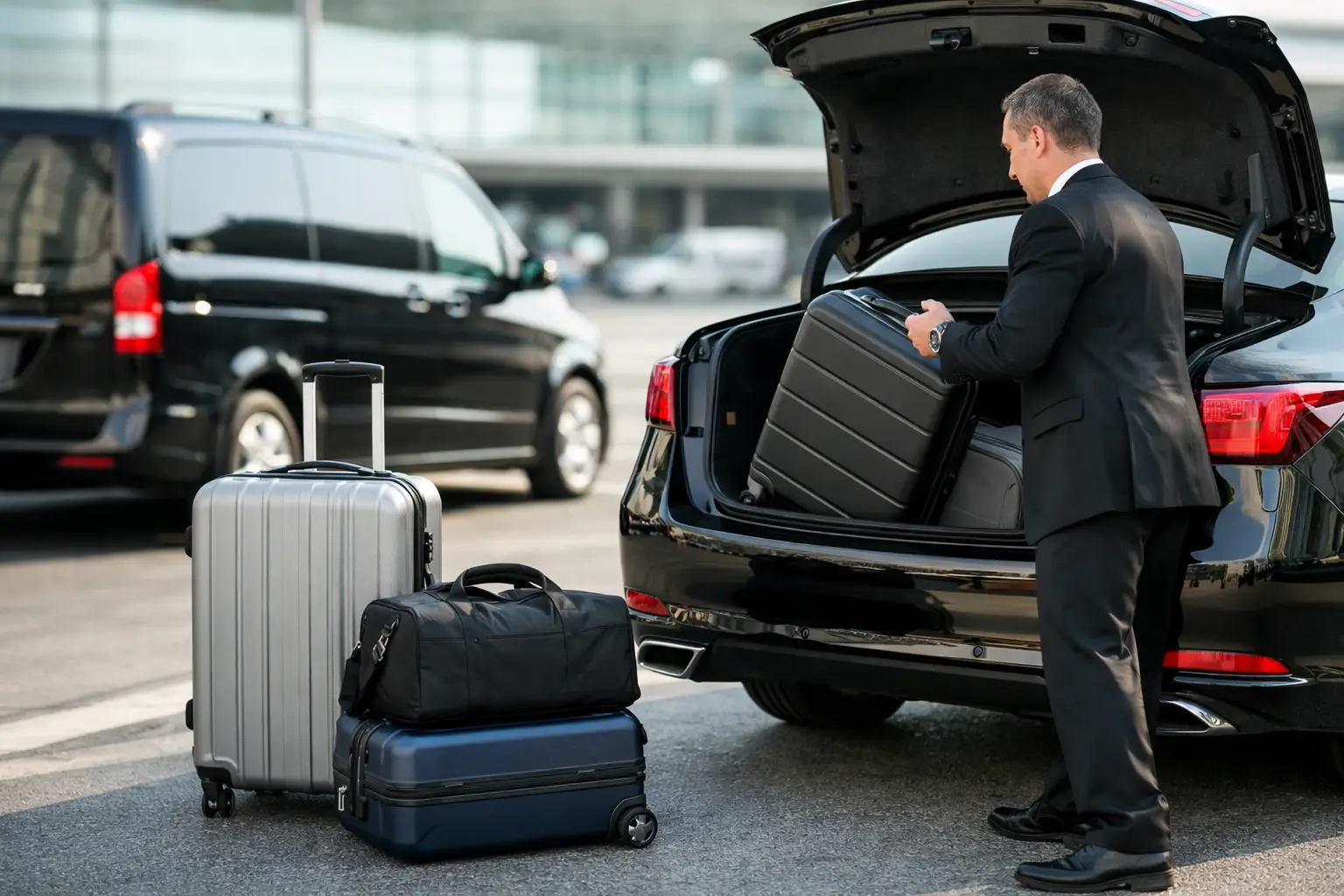
A delayed baggage belt is frustrating enough. Discovering that your cases do not comfortably fit in the vehicle waiting outside can make the first part of a holiday unnecessarily difficult. That is why driver luggage allowance should be checked when arranging a private transfer, especially for airport arrivals, family trips and longer journeys through the Algarve.
For private transport, luggage capacity is not usually a single fixed allowance per person. It depends on the vehicle type, the number of passengers, the size and shape of each item, and whether you are travelling with equipment such as a pushchair, golf clubs or a wheelchair. Giving accurate luggage details before booking helps ensure the right vehicle is allocated for a comfortable door-to-door journey.
What driver luggage allowance means on a private transfer
In private airport transport, driver luggage allowance refers to the amount and type of baggage that can be safely carried alongside passengers. It is a practical capacity question rather than an airline-style weight limit. A vehicle may have enough seats for four people, for example, but four large hard-shell cases, four cabin bags and a pushchair may require more boot space than that vehicle provides.
The goal is not simply to make every item fit. Luggage should be loaded securely, without reducing passenger comfort or obstructing safe access to seats. This matters even more after a flight, when travellers expect to sit comfortably rather than hold bags on their laps for the journey to their accommodation.
A professional driver will load luggage with care, but they need the correct information in advance. The more precise the booking details, the easier it is to match your party with a suitable car, estate vehicle or larger private transfer option.
Luggage size matters as much as the number of bags
Saying that you have "four bags" is useful, but it does not tell the whole story. Four small cabin cases take up far less room than four large checked suitcases. Soft holdalls can sometimes be positioned more flexibly than rigid cases, while oversized luggage often needs a vehicle with additional capacity.
When describing your luggage, separate it into standard checked cases, cabin bags and special items. A typical large suitcase is often the item that determines whether a standard car is appropriate. Cabin cases, handbags and small backpacks may fit around the main luggage, but they still need to be accounted for.
If you are unsure how to classify a bag, think about where it would normally travel on a flight. A case checked into an aircraft hold is generally larger than a cabin bag. If your luggage is unusually wide, tall or heavy, mention this clearly rather than assuming it will fit in the boot with standard cases.
Common items that need advance notice
Some belongings are not covered by an ordinary suitcase count. Pushchairs, travel cots, golf bags, surf equipment, folding wheelchairs, bicycles in bags and large musical instruments can all affect vehicle choice. They may fit comfortably in a larger vehicle but leave little room in a standard saloon car.
Child seats also take up passenger space. If children are travelling and a child seat is required, provide the child’s age or size where requested, as well as the full luggage count. This allows the transfer to be planned around both safety and space.
Passenger numbers and luggage capacity must work together
A common mistake is to select a vehicle based on the number of seats alone. Seat capacity and luggage capacity are related, but they are not identical. The fuller the vehicle is with passengers, the less flexibility there may be for extra bags, particularly on a transfer from Faro Airport with a group arriving for a week or more.
Couples often have more room for luggage in a standard private vehicle, provided they are carrying ordinary cases. Families and small groups may need a larger option even where the passenger total appears modest. Three adults with three large cases, three cabin bags and a pushchair can require more space than four adults travelling with only hand luggage.
There is also a comfort trade-off. It may be physically possible to carry additional bags inside the passenger area, but that is not always the right arrangement for a journey of an hour or more. A suitable vehicle should leave space for everyone to travel comfortably and enter or leave the car without difficulty.
How to provide accurate luggage details
Before confirming your transfer, count everything that needs to travel with you. Include checked cases, cabin cases, backpacks, handbags where substantial, child equipment and specialist items. Do not forget bags collected at the airport, duty-free shopping or items that may be packed separately for the flight.
It is helpful to state the number of passengers first, followed by luggage by size. For example: two adults, two large suitcases, two cabin cases and one golf bag. This is much clearer than simply writing “five pieces of luggage”.
If your plans change after booking, advise the transfer provider as soon as possible. Adding an extra passenger or two large cases shortly before arrival can alter the vehicle requirement. Early notice gives the best chance of arranging suitable capacity without disrupting your collection time.
For a private transfer with Lisbon Seville Faro Riders, clear booking information supports a properly planned pick-up, with the vehicle matched to the needs of the journey wherever possible.
When you may need a larger vehicle
A larger vehicle is worth considering when you have several full-size suitcases, are travelling as a family, or are carrying any item that cannot be treated as normal luggage. It can also be the better choice when you simply prefer more room after a flight.
Choose additional capacity if your group includes any of the following:
- Four or more travellers with checked luggage
- A pushchair, travel cot or child seat alongside suitcases
- Golf clubs, sports equipment or oversized items
- Mobility equipment, including folding wheelchairs
- Long-stay holiday luggage or multiple bags per passenger
This does not mean every group needs the largest vehicle available. Two people with two medium cases do not need the same arrangement as six people travelling with a week’s worth of bags. The right option depends on the whole load, not one item in isolation.
What to expect when meeting your driver
At collection, place your luggage together so the driver can assess and load it efficiently. Keep passports, medication, valuables, electronics and essential travel documents with you rather than packing them deep inside a suitcase. These items are better kept accessible throughout the journey.
The driver will normally handle the loading, but passengers should point out fragile items, equipment that must remain upright, or bags containing anything that needs particular care. If you have an item that cannot be placed in the boot or luggage area, raise this before departure rather than attempting to travel with it unsecured.
Private transfers are designed to remove avoidable airport stress. Accurate luggage information helps protect that benefit, ensuring that the vehicle is suitable before you land rather than leaving capacity to chance at the kerbside.
A quick check before you book
Take one minute to compare your passenger count with every item you will bring. Check case sizes, include special equipment, and consider whether your journey is short enough that reduced space would genuinely be acceptable. For most airport transfers, choosing enough room from the start is the more comfortable and reliable option.
A clear luggage declaration is a small part of the booking process, but it has a direct effect on collection, comfort and the first kilometres of your trip. When in doubt, declare the extra item and request guidance before you travel.