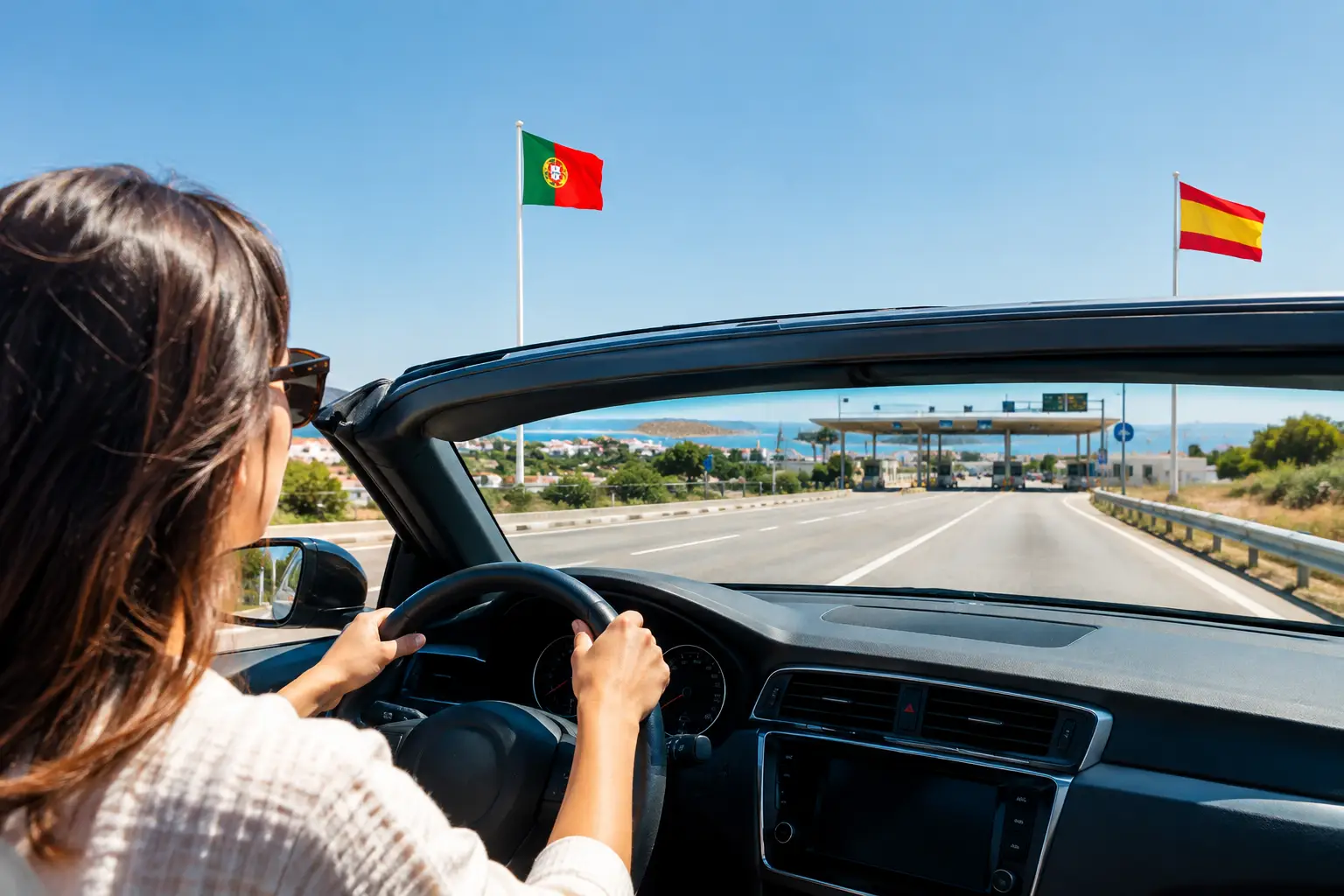
The easiest answer to how to cross border from Algarve is to travel east towards Vila Real de Santo António and cross the Guadiana International Bridge into Ayamonte, Spain. For most visitors, the crossing itself is straightforward. The planning matters more: choosing the right transport, carrying the correct documents and allowing realistic time for the onward journey to Huelva, Seville or another Spanish destination.
For travellers arriving at Faro Airport, a pre-arranged private transfer is often the most direct option, particularly after a flight, with luggage, children or a fixed hotel check-in time. Driving yourself can work well too, but it brings rental permissions, tolls and unfamiliar roads into the equation.
How to cross the border from Algarve by road
The main road crossing between the Algarve and south-west Spain is the Guadiana International Bridge, linking Vila Real de Santo António in Portugal with Ayamonte in Andalusia. From Faro, follow the A22 eastbound towards Vila Real de Santo António, then continue towards the bridge. Once across, Spanish roads connect directly to the A-49 for Huelva and Seville.
There is no routine border booth or standard passport-control queue between Portugal and Spain because both countries are in the Schengen Area. That does not mean you should travel without identification. Authorities can carry out checks, and accommodation providers, rental firms or transport operators may require your documents.
The route is generally simple, but it is worth allowing extra time in summer, around public holidays and on weekends. Traffic can build around resort departures, roadworks and popular Spanish shopping periods. A journey from Faro Airport to Ayamonte usually takes around one hour in normal conditions. Continue to Seville and the total road journey is commonly around two and a half to three hours, depending on traffic and your final address. From Albufeira, allow longer.
Portugal and mainland Spain use different time zones. Spain is one hour ahead of Portugal. This is easy to overlook when confirming a restaurant reservation, meeting a driver, catching a bus or arranging a hotel arrival. Your mobile phone should update automatically once it connects to a Spanish network, but confirm all booked times before travelling.
Documents British travellers should carry
British passport holders need a valid passport for travel between Portugal and Spain, even though there is normally no fixed stop at the border. Keep it accessible rather than packed inside a large suitcase. Your passport should meet the Schengen entry requirements, including validity rules, and time spent in Portugal and Spain counts together towards the 90 days in any 180-day period allowance for short stays.
If you are driving, carry your driving licence, rental agreement, vehicle insurance details and any documentation supplied by the rental company. Do not assume a Portuguese hire car may automatically enter Spain. Many firms permit cross-border travel only with advance authorisation and may charge an additional fee or require specific insurance cover. Check this before collecting the vehicle, not when you are already heading east on the A22.
Travelling with children requires a little more preparation. Each child needs their own valid travel document. If one parent or guardian is travelling alone, particularly where surnames differ, supporting documents can prevent avoidable questions from an airline, hotel or authority.
Choose the transport that suits your journey
Your best option depends on where you are starting, where you need to finish and how much flexibility you want on arrival.
Private transfer: direct and practical
A private cross-border transfer removes the main logistical steps. A professional driver collects you at Faro Airport, your hotel or another agreed address, manages the route and takes you directly to your Spanish destination. There is no car-hire collection queue, no need to understand Portuguese toll arrangements and no changing vehicles with cases at a bus station.
This is particularly useful for families, small groups and travellers staying outside major city centres. It also makes sense for arrivals late in the day, when scheduled public transport can be limited or poorly matched to flight times. The benefit is not simply comfort. It is knowing the vehicle, pick-up point and destination are arranged before you land.
Lisbon Seville Faro Riders provides pre-arranged private transfers for travellers who need direct transport between the Algarve and Spanish destinations, with modern vehicles and professional drivers.
Hire car: freedom with extra responsibility
A hire car gives you the flexibility to stop in Tavira, Vila Real de Santo António, Ayamonte or Huelva along the way. It can be good value for a longer multi-stop holiday, especially if you plan to explore rural areas where public transport is less frequent.
The trade-off is administration. Confirm cross-border approval, understand how Portuguese electronic tolls are charged and check parking arrangements at your Spanish accommodation. Seville has controlled-access areas, narrow streets and limited central parking, so a hotel with clear vehicle access can make a substantial difference. Check whether your accommodation has a nearby car park before following satellite navigation into the historic centre.
Bus: possible, but check the full timetable
Bus travel can be suitable for solo travellers on a flexible schedule. Some routes operate between Faro and Seville, while others require a connection, often through Huelva or Ayamonte. Services, departure points and seasonal frequency can change, so check the full journey rather than relying on an old timetable or assuming a daily direct service.
A bus may be less convenient if you are carrying several cases, travelling with young children or landing after the final departure. It also leaves you responsible for getting from Faro Airport to the bus station and from the Spanish station to your accommodation. The advertised journey time rarely includes those transfers.
Train and ferry: better for slow, local travel
There is no simple rail route from Faro straight to Seville. You can travel by regional train towards Vila Real de Santo António and use the ferry from there to Ayamonte, but this is a local travel option rather than an efficient airport-to-Seville solution. Ferry schedules can vary by season and conditions, and you must account for luggage handling and the one-hour time difference after arrival in Spain.
It can be a pleasant choice if Ayamonte is your destination and you want to travel at a relaxed pace. For a fixed onward connection or a late arrival, road transport is usually more dependable.
Plan for tolls, fuel and road rules
The Algarve's A22 motorway uses an electronic toll system in many sections. If you have a Portuguese rental car, ask how the hire company manages toll payments and whether a transponder is fitted. Keep any agreement or receipt until the final charge is settled. With a private transfer, this is handled as part of the journey planning.
Fuel stations are readily available on the Portuguese and Spanish motorway networks, but prices and payment methods can differ. Fill up before returning a rental vehicle if your agreement requires it. Also check the basic equipment and local rules that apply to your car. Speed limits, parking controls and low-emission restrictions are enforced, especially in larger Spanish cities.
Avoid planning the journey around the shortest map estimate. Add time for the airport collection process, comfort stops, fuel, traffic and finding the correct entrance to your accommodation. For an airport arrival, it is sensible to build in a buffer after your scheduled landing time for baggage reclaim and possible delays.
Before you leave the Algarve
Confirm your destination address, contact number and expected arrival time in Spain. This sounds simple, but rural villas, gated developments and historic-centre properties can be difficult to locate if the address is incomplete. Download offline maps if you are driving, as mobile coverage can be uneven in less populated areas.
Keep passports, medication, valuables and a charger with you rather than in the boot. If you have an early flight from Faro after staying in Spain, reverse the timing carefully: Spain is an hour ahead, but Faro Airport operates on Portuguese time.
A well-planned crossing is rarely complicated. Choose transport that matches your luggage, group size and arrival time, keep your documents ready and give the journey enough room in your schedule. That leaves you free to arrive in Spain settled, on time and ready to enjoy the next part of your trip.